
Thomas A. McNally, MD Jul 19 | 8 min read By Thomas A. McNally, MD…
When Should You See a Spine Specialist for Back or Neck Pain?
Most people with back or neck pain don’t start by calling a spine surgeon. In most cases, symptoms improve with time, activity modification, physical therapy, medication, or other treatment.
But there is also a point when waiting for things to get better can turn into simply learning to live around the problem.
I see this frequently in my practice. A patient will tell me the pain “isn’t that bad,” but then describe how they no longer walk as far as they used to. They’ve stopped playing golf or exercising. They avoid certain chairs, think twice about traveling, or plan their day around how long they can stand before their leg starts to hurt.
Without realizing it, their life is being organized around their pain.
That is often a good reason to seek a spine specialist’s opinion. The question isn’t simply whether you need surgery. It is what is causing your symptoms, whether the condition is likely to improve, and which treatment gives you the best opportunity to get back to the things you want to do.
The Right Treatment Starts With the Right Diagnosis
Back and neck symptoms can come from many different sources. Disc herniations, spinal stenosis, degenerative changes, spondylolisthesis, scoliosis, fractures and other conditions can produce similar symptoms but may require very different treatment.
That is why diagnosis matters.
For most patients, nonsurgical care is the appropriate place to start. Physical therapy, medication, injections, activity modification and other treatments can be very effective.
For others, surgery may be the most appropriate treatment. A pinched nerve, significant spinal stenosis, instability, progressive deformity or another structural problem may not adequately respond to conservative treatment. Surgery may also become appropriate when symptoms persist despite treatment and substantially interfere with a patient’s function or quality of life.
The decision is individual. The purpose of an evaluation is to understand the problem well enough to make the right treatment decision.
When Should You Make an Appointment?
There isn’t one rule based on how many days or weeks you’ve been in pain. I pay particular attention to the nature of the symptoms, whether they are changing and what they are preventing a patient from doing.
It may be time for a spine evaluation when:
- Back or neck pain persists despite appropriate initial treatment.
- Pain repeatedly improves and returns.
- Pain travels into an arm or leg.
- You have numbness, tingling or weakness.
- Walking or standing has become increasingly difficult.
- Your symptoms interfere with sleep, work, exercise, travel or normal activities.
- You have tried physical therapy, medication, injections or other treatment without sufficient improvement.
- You have been given a diagnosis or MRI result and want to better understand the condition and your treatment options.
You don’t have to wait until the pain becomes unbearable. A meaningful change in function can be just as important.
What Happens at the First Appointment?
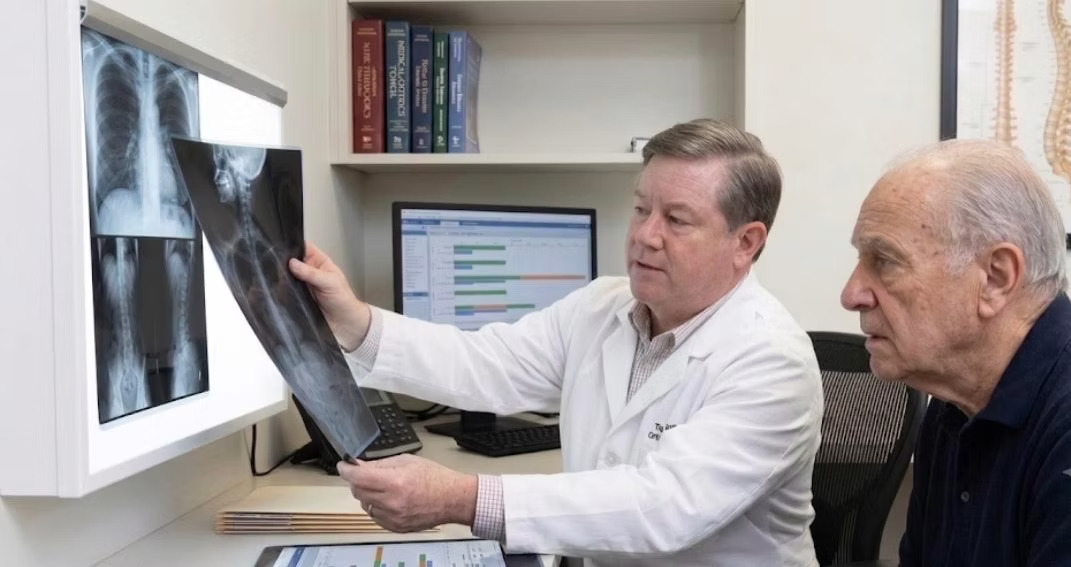
A spine evaluation begins with understanding the patient, not simply looking at x-rays or an MRI.
I want to know where the symptoms are, when they started, what makes them better or worse, whether there are neurologic symptoms, what treatment has already been tried and what the problem is preventing the patient from doing.
The physical examination helps determine whether symptoms may be coming from the cervical, thoracic or lumbar spine and which nerves are involved.
If a patient already has X-rays, an MRI, CT scan or other imaging, I review those images alongside the examination and symptoms. Imaging can identify the structural problem, but the findings need to make sense in the context of what the patient is experiencing.
From there, we can discuss the diagnosis and treatment options.
Usually the best next step is continued nonsurgical treatment. Sometimes additional testing is necessary. And when surgery is appropriate, we can discuss what operations might be indicated, why they are options, the expected recoveries and whether a minimally invasive or endoscopic approach may be an option.
The objective is not to avoid surgery or rush toward it. It is to choose the treatment that makes sense for that patient and that condition.
When You Shouldn’t Wait
Some symptoms require more prompt evaluation.
New or progressive weakness in an arm or leg, significant difficulty walking or maintaining balance, loss of bowel or bladder control, numbness in the groin or saddle area, or severe symptoms following significant trauma should not simply be watched at home.
Severe pain accompanied by fever, unexplained weight loss, a history of cancer or certain other medical conditions may also warrant more urgent evaluation.
Depending on the symptoms and their severity, that may mean contacting your physician promptly or seeking emergency care.
Pay Attention to What You’ve Stopped Doing
Pain scores don’t always tell the whole story.
Someone may describe their pain as a four out of ten but have made significant changes to accommodate it.
Can you walk the distance you want to walk? Sleep comfortably? Exercise? Work? Travel? Pick up your child or grandchild? Sit through dinner without constantly changing position?
Those changes matter.
If a back or neck problem is beginning to dictate what you can and cannot do, or if treatment hasn’t gotten you where you need to be, it may be time to understand the problem more fully.
The goal is not simply to treat an MRI or eliminate pain. It is to identify what is limiting you, balance risk and benefits, and determine the treatment most likely to help you get back to living your life.
Dr. Thomas A. McNally is a board-certified orthopaedic spine surgeon specializing in minimally invasive and complex spine surgery. He cares for patients throughout the Chicago area with offices in Chicago and Elk Grove Village. His approach to spine care focuses on understanding each patient’s symptoms, reviewing the underlying structural problem, and determining the treatment most likely to restore function and quality of life.

Related Posts


Comments (0)